
Aadhaar Seeding Report on Bhoomi RTC: Karnataka Land Records Guide
If you own agricultural land in Karnataka, your property exists in two worlds. One is the physical world of soil, fields, and crops. The other is the digital world of government land records, where authorities store and manage your land information. To use both systems smoothly, you need to link your Aadhaar card to your land record on the Land Portal. The Land Portal creates this link through a process called Aadhaar seeding. It also generates an Aadhaar seeding report to track the status of the linkage.
This guide breaks it all down — what the report is, why it’s important. How to check it, and what it means for you as a landowner or potential buyer in Karnataka.
What Is the Bhoomi RTC Portal?
Before diving into Aadhaar seeding, it helps to understand the platform on which it rests. Bhoomi Karnataka is the state government’s flagship digital land record system, which it launched in 2000. The name itself means “land” in Kannada, and the mission was simple – to take the mountains of paper-based land records sitting in taluka offices across the state and bring them into a transparent, publicly accessible digital system.
What Does “Aadhaar Seeding” Mean?
Aadhaar seeding, in its basic form, is the process of linking a farmer’s Aadhaar number to their land record (RTC) in the land database.
Think of it this way: The RTC tells you who owns a piece of land. But without any biometric verification, how does the government—or a bank, or a court—confirm that the person claiming to be the owner is actually who they say they are? That’s exactly what Aadhaar seeding does.
When your Aadhaar is successfully linked to your RTC:
In short, Aadhaar seeding transforms a static paper record for your land into a living, verified, secure digital identity.
What Is the Aadhaar Seeding Report on Bhoomi RTC?
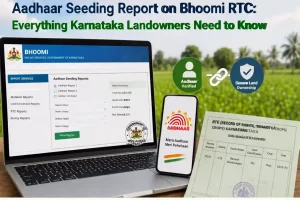
The Aadhaar Seeding Report is a publicly viewable report available in the Report Services section of the Bhumi Portal. It displays the current Aadhaar linkage status for land records across Karnataka—by district, taluka, hobli, and village.
This is not just a personal record. It serves as an administrative and transparency tool that allows:
Types of Aadhaar Seeding Reports Available on Bhoomi
When you go to the Base Seeding Reports section on the Land Portal, you will find three distinct types of reports:
1. Aadhaar Report 1
This report provides a comprehensive overview of surveying activities in a selected area. It typically shows the total number of land parcels and how many have been successfully linked to the database, helping both citizens and officials get an immediate picture of coverage.
2. Aadhaar Report 2
This report further breaks down that status, including parcels where Aadhaar seeding has been attempted but not yet verified (E-KYC pending).
3. Aadhaar VAO Report
VAO stands for Village Accountant Officer – A revenue officer at the grassroots level who is responsible for maintaining the land record at the village level. This report is specifically designed to help VAOs track seed development in their assigned villages and take corrective action where necessary.
Why the Karnataka Government Launched This Initiative
The Aadhaar Seeding campaign on land is part of a broader state-level initiative to prevent land fraud and protect private and public land assets.
Karnataka has millions of private landholdings across the state, and the Aadhaar seeding initiative has been running for several years as part of the state’s broader effort to secure land records digitally. Exact seeding-completion figures change regularly — check the official Bhoomi Aadhaar Seeding Report for current numbers in your district.
The Karnataka Revenue Department has launched Aadhaar seeding alongside the Land Batt initiative—a parallel campaign focused on identifying government-owned land and protecting it from encroachments. Together, these two programs represent the most serious attempt to secure the state’s land records ecosystem.
The scale of the work reflects how seriously the government took it: Aadhaar seeding was attempted for over 27.6 million private plots, and E-KYC was completed for over 18.7 million plots by mid-2024. During this process, more than 6.3 million unique farmers were identified who own multiple plots. – An insight that helps the government provide more targeted agricultural assistance.
To date, approximately 53% of Karnataka’s landowners have completed the Aadhaar seeding of their land records, with the government pushing for full coverage.
Benefits of Aadhaar Seeding for Karnataka Landowners
Prevents unauthorized land transfers
Once your Aadhaar is linked to your RTC, identity verification is required for any application involving changes to your land. This effectively prevents anyone from fraudulently transferring your property without your knowledge or consent
Faster access to agricultural schemes
Government schemes for farmers—from crop loan waivers to the Parihara Disaster Relief Scheme—are increasingly tied to swift land ownership verification. An Aadhaar-seeded land record ensures you receive benefits without any delay or dispute.
Smooth Bank Loan Process
When you approach a bank for an agricultural or land mortgage loan, the bank needs to verify both your identity and your land ownership. With Aadhaar seeding, both checks happen in a digital step, significantly reducing the paperwork burden.
Peace of Mind for NRI Farmers
Thousands of Karnataka residents living abroad own hereditary agricultural land in the state. Without physical presence, verifying ownership has traditionally been difficult. Aadhaar seeding, combined with the 24/7 digital access of the Bhumi Portal, provides NRIs with a reliable layer of protection over their land.
Transparency at the Village Level
Public access to Aadhaar Seeding reports means that local communities can independently verify the seeding status of land in their village—adding a layer of social accountability that was never present in a paper-based system.
How to Check the Aadhaar Seeding Report on Bhoomi RTC
Accessing the Aadhaar seeding report is easy and requires no login or registration. Here is the step-by-step process:
1: Open your browser and visit the official land portal at landrecords.karnataka.gov.in.
2: On the homepage, find the “Report Services” section in the navigation menu or main dashboard.
3: From the list of available report options, click on “Aadhaar Seeding Reports.”
4: A new page will load where you can select the report type — Aadhaar Report 1, Aadhaar Report 2, or Aadhaar VAO Report.
5: Use the drop-down menu to select your district → taluka → hobli → village to filter the report by your area.
6: The report will display the status of the selected area, including how many land records have been attached and any pending cases.
How to Link Your Aadhaar to Your Land Record on Bhoomi
If, after checking the report, you find that your land parcel is not yet Aadhaar-seeded, here’s how you can start the process:
Final Thoughts
The Aadhaar seeding report on the Land RTC is more than just an administrative requirement. It creates a secure digital link between a landowner’s identity and their property records. This connection offers several important benefits. It improves security and makes it easier for landowners to access agricultural loans and credit. In addition, it helps ensure eligibility for government schemes and provides stronger protection against land fraud.
If you are a farmer in Karnataka, check whether you have linked your Aadhaar to your land records. The process is simple, access to the portal is free, and the protection it provides is worth a few minutes. Your land record has always been yours. Aadhaar seeding simply ensures that the digital world knows it too.


